








Interview with Kazakhstan National Volleyball Federation Secretary General Meirbek Nuguspanov
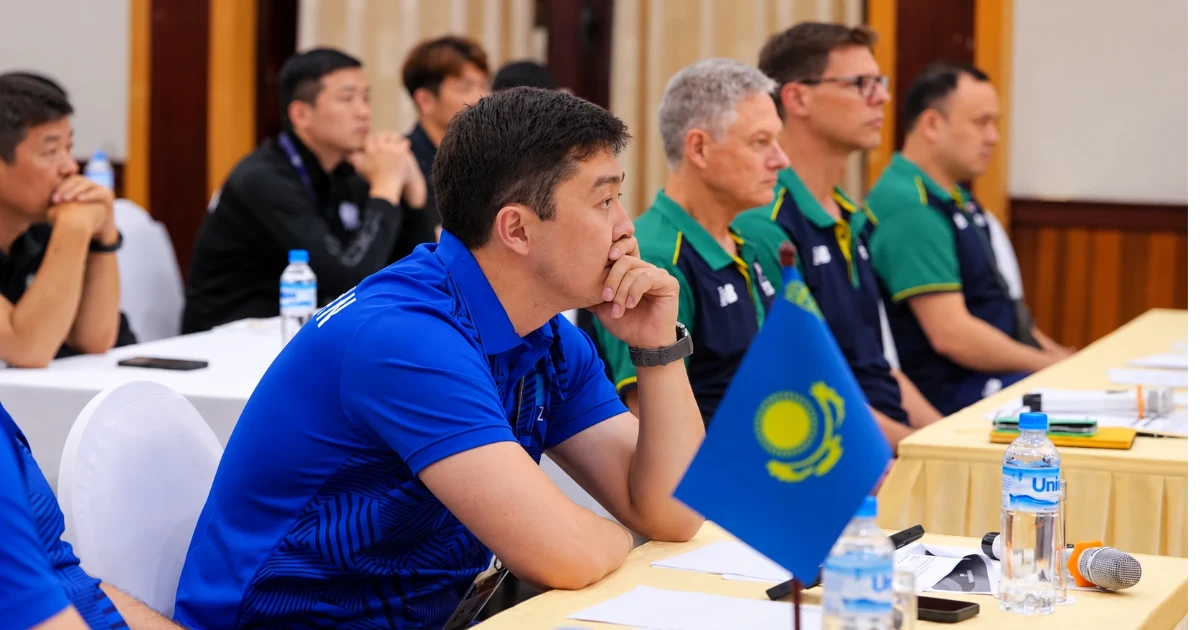
On September 28, 2026,
Meirbek Nuguspanov was appointed Secretary General of the organization by order
of the President of the Kazakhstan National Volleyball Federation.
In an interview with the
federation’s press service, Meirbek Musabekovich shared his vision for the
development of volleyball in Kazakhstan, discussed current challenges, and
outlined future prospects.
— Meirbek
Musabekovich, the Kazakhstan Volleyball Federation recently underwent
re-registration and became the Kazakhstan National Volleyball Federation. What
prompted this change?
— This was required
under the current Rules for the Accreditation of Sports Federations, approved
by the Ministry of Tourism and Sports. Only one national federation can be
accredited for each sport in Kazakhstan, and regional federations must be its
members. We therefore established a unified structure that brings together all
forms of volleyball in Kazakhstan: indoor, beach, sitting volleyball, snow
volleyball, and veterans’ volleyball.
On September 26, the
first conference of the Association of Legal Entities “Association of the
Kazakhstan National Volleyball Federation” took place. It brought together
almost all regional federations, as well as the Sitting Volleyball Federation
and the Veterans Volleyball Federation of the Republic of Kazakhstan.
The conference elected
Madi Tokeshevich Takiev as federation president for a four-year term. The
federation’s leadership was then formed by presidential order:
First Vice President —
Arman Nurlanovich Kabesov;
Vice President for
Sports Operations — Zhandos Baktbekovich Bairkhanov;
Vice President for
Sitting, Beach and Snow Volleyball — Duisenbay Nurbayevich Turganov;
Secretary General —
myself.
— Could you explain
your powers and responsibilities in your new position?
— As Secretary General,
I am responsible for the overall development of volleyball.
My responsibilities
include leading and managing the day-to-day work of a team that includes the
Refereeing Committee, International Committee, Legal Department, Marketing, IT,
and the Competition Organization and Licensing Department.
I pay particular
attention to the quality of officiating. Qualified referees and inspectors must
be assigned to every match. Confidence in our championship depends directly on
this.
There are many issues
that need to be addressed, and I am not promising rapid reforms. The federation’s
immediate priority is to help clubs organize their matches. The First Vice
President is visiting all regions. Each region has its own volleyball-related
challenges. Arman Nurlanovich meets with regional governors and deputy
governors. Implementation is then handed over to me, and I oversee the
execution of decisions and agreements reached with regional leadership.
This year, the KNVF
strategy focuses on working together with every club to help them resolve their
particular problems.
— This season, the
format of the men’s and women’s National Leagues has changed from a
tournament-based system to a home-and-away format. Two rounds have already been
played in the women’s league and one in the men’s league. What challenges have
the federation and clubs faced during this transition?
— The main challenge is
organizing home matches. Under the previous system, some clubs and cities
hosted rounds infrequently, and their infrastructure was not ready for the new
format.
For volleyball to
develop fully across the regions, every city needs at least one properly
equipped arena. This primarily means good lighting, professional sports
flooring, and a video replay system. If everything is organized correctly once,
the investment will serve the club for a long time: the season is long, and the
arena will be used regularly. Spectators also enjoy visiting a venue that looks
attractive and modern.
For the federation, the
main challenge is the availability of qualified referees. Four matches can take
place simultaneously in different cities, requiring eight to twelve strong
officials. We are working on this. I am confident that the situation will
improve by the end of the season and that all referees will receive equal
opportunities to officiate and gain the necessary experience.
One important detail is
that reserve teams travel alongside the main squads. The reserve team plays in
the morning, while the first team plays in the afternoon or evening.
My task is to make this
transition as smooth as possible for both clubs and the federation. Our goal is
to build a system that operates without disruptions.
— How do you assess
the current state of volleyball in Kazakhstan, and which areas, beyond changing
the championship format, need to be improved in the near future?
— Our main advantage is
a strong and competitive domestic championship, for both men and women. We must
build on this foundation to improve the results of our national teams.
My first proposal is to
prohibit clubs from signing foreign players for the setter position. We have
strong attackers, while young setters either play for weaker clubs or sit on
the bench. At the same time, the national team’s main setters are already older
players. Such a restriction would give younger setters more playing time, and
the national team would benefit from it.
Second, we need more
matches in youth volleyball. Youth volleyball is growing rapidly, and young
players need competitive experience at the national level. We are proposing a
pilot project that would divide the country into four zones. Zonal tournaments
would take place in autumn, winter and spring, with the best teams meeting in a
final tournament in summer. If approved, the project would launch in a year. In
the longer term, I would like to see a full youth regular-season championship,
with teams playing one another on weekends throughout the school year.
Third, we need to pay
more attention to the national teams by organizing training camps and ensuring
comprehensive preparation for international competitions.
Finally, we are
developing regulations for the Kazakhstan Snow Volleyball Championship and plan
to launch it in 2027. This is a promising discipline for us: Kazakhstan is one
of the northernmost countries in Asia, and our beach volleyball players are
already performing successfully at international level.
We will first discuss
all these proposals within the federation, then at the Executive Committee, and
subsequently with clubs and regional federations. Such issues cannot be
resolved overnight, but consistent work will certainly produce results.
— How important is
it to establish unified requirements for clubs regarding infrastructure,
medical support, youth development and fan engagement?
— This is one of the
key issues. National League clubs are already required to have reserve teams.
The next step we are preparing is to require every club to establish a youth
academy with three or four teams across different age groups, as in our youth
championship.
In addition, each club
must have its own playing hall or rent one with good lighting and seating for a
specified number of spectators.
Medical support is
another important area. A doctor must be present at every match, and players
must undergo comprehensive medical examinations before the season. Athletes’
health is not an area where savings should be made.
Fan engagement is
equally important. Every club should maintain its social media accounts,
announce matches in advance and make its home games visually appealing. We want
people to come to the arena not only to watch volleyball but also to enjoy the
experience. The home-and-away format gives clubs an opportunity to build a
regular fan base in their own cities.
At the same time, we
take the actual capabilities of each region into account and cannot demand everything
at once. Negotiations with clubs are ongoing, and our task is to help everyone
move towards a common standard over time.
Volleyball cannot
develop without infrastructure. Wherever I have been in the world, the process
always begins with building the necessary foundation. Only then can we talk
about results and mass participation.
One of my goals is to
invite an expert coach from the International Volleyball Federation (FIVB). The
expert would visit the regions and conduct seminars for youth coaches.
— How do you see
the development of a commercial model for volleyball clubs that would gradually
reduce their dependence on public funding and attract more private partners?
— This is a must-have
for every club. A sponsor is a financial safety net. Even if a partner covers
just five to ten percent of a club’s budget, that is already significant
support. If a sponsor covers half the budget, the club’s situation changes
considerably.
I am confident that the
move to a home-and-away format has made volleyball much more attractive to
businesses because audience reach has increased. The very first round of the
Women’s National League attracted around 45,000 online views, and this figure
will continue to grow as many people watch matches on demand.
We schedule clubs’ home
matches during the evening prime-time window. This gives clubs an opportunity
to invite sponsors and regional officials. The federation has provided the
foundation by introducing a new championship format. Now it is up to the clubs
to turn it into a show and learn how to sell it. Good lighting, quality
flooring and an attractive venue are the foundations of a commercial product.
There are already
examples of success. Some clubs have organized their home rounds very well and
are filling their arenas. I believe that by the middle of the season, such
clubs could introduce paid tickets and season passes.
The federation is also
seeking partners for the championship and national teams. The stronger the
league brand becomes, the easier it will be for individual clubs to negotiate
with their own sponsors.
— What role should
digital platforms, social media and modern fan-engagement tools play in the
development of volleyball?
— Today, everyone has a
smartphone, and people receive most of their information through it. The
digital environment is no longer an optional extra; it is an integral part of
modern life. If we want to attract an audience, we need to be where people
spend their time — on their phones.
All National League
matches are now broadcast. Fans anywhere in the world can visit the
federation’s portal and watch their team play live or on demand.
But broadcasts are only
the beginning. We need to cover all of Kazakhstan’s volleyball systematically:
results, schedules, statistics, video highlights, and interviews with players
and coaches. People are interested not only in matches but also in stories: how
a team lives, what happens in the locker room and the journey a player has
taken. This is the kind of content that turns viewers into fans.
This is directly
connected to commercial development. Sponsors today look at audience reach and
engagement. The stronger the digital presence of the league and its clubs, the
easier it becomes to attract partners. We will therefore encourage clubs to
maintain active social media accounts and invest in content.
And, of course, this is
a way to reach young people. A child who sees an engaging volleyball video may
well decide to take up the sport.
— What changes are
needed in sports coverage to raise the profile of players, clubs and national
teams?
— First of all, we need
to build anticipation. Look at any major sporting event in the world: the FIFA
World Cup, UFC tournaments, boxing or judo competitions. Interest begins to
build long before the event starts. Volleyball needs the same approach, not
only on social media but also on television and radio. Volleyball must remain
visible and relevant to the public.
Content formats must
also be modern: short videos, interviews, team stories and highlights. People
need to connect emotionally with athletes. To achieve this, we must show the
full range of emotions: the joy of victory, the disappointment of defeat and
life behind the scenes. This kind of content turns a player into a personality
whom people want to follow.
Second, we need higher
broadcast standards. Three cameras and a commentator are the minimum. We must
go further by introducing drone footage, a mobile camera operator courtside,
unexpected camera angles and replays of key rallies. We will start with the
National League and gradually extend these standards to the Higher League,
youth volleyball, sitting volleyball and beach volleyball.
Third, we need to
promote standout personalities. Some of our players already have large social
media followings, and they can help us attract new audiences to volleyball. A
recognizable player benefits the entire sport: the club, the national team and
sponsors.
— What three
outcomes would you like to achieve by the end of your first year in office?
— First and foremost,
we must fully settle the federation’s outstanding debts to referees and
national team players. As I have already said, it is impossible to talk about
development until this issue is resolved.
Second, every National
League club should have a home arena of an appropriate standard. We regularly
encounter shortcomings, and not every team is ready to host matches. Our goal
is for any city to be able to host a round to a high standard at any time. Once
this is achieved, clubs will be able to focus seriously on commercial activities:
selling tickets, season passes and sponsorship packages. Clubs themselves
should be the ones generating revenue in the first instance.
Third, we need to
approve key reforms. These include a new zonal format for the youth
championship, which we want to launch in 2027, and restrictions on foreign
setters, which could take effect from the 2027/28 season.
If, in a year’s time,
we can say that the debts have been paid, the arenas are ready and the reforms
have been approved, then our first year will not have been wasted.
— What results,
several years from now, would objectively demonstrate that volleyball in
Kazakhstan has reached a new stage of development?
— First and foremost,
the results of our national teams. They are the main measure of a country’s
volleyball standard. All our work on the championship, young setters and youth
volleyball must ultimately contribute to the success of the national teams.
The second indicator is
audience reach. We have leagues to look up to: South Korea, Türkiye, Brazil,
the United States and Russia. Our championship must also become a prominent,
recognizable product. A strong, well-promoted league will help attract major
partners for both clubs and the federation.
The third indicator is
mass participation. We want to see more people playing volleyball across all
disciplines and age groups, including children, young people and veterans, as
well as beach and sitting volleyball. Beach volleyball is developing actively
in Kazakhstan, and our players are achieving good results at Asian level. It is
important that courts and tournaments are established not only in major cities
but also across the regions.
Sitting volleyball is a
discipline we are particularly proud of. Our athletes won bronze medals at the
World Championship and currently rank second in the world rankings. In just a
few days, they will compete at the Asian Para Games in Japan, and we will all
be cheering them on. Our task is to enable as many people with disabilities as
possible to take up the sport. This requires local clubs, coaches and
accessible sports halls in every region.
This is a major
undertaking that requires time, professionalism and the involvement of everyone
connected with volleyball in Kazakhstan.
I would also like to
take this opportunity to address our referees. I know that many of you have
waited a long time to be paid for your work, and I understand how difficult
that has been. Thank you for your patience and for continuing to officiate
matches to a high standard despite these circumstances. We have already settled
part of the outstanding debt and are continuing to work on the remainder. I
give you my word: the federation will pay all outstanding amounts in full.
Referees are an integral part of our volleyball community, and we will treat
your work with the respect it deserves.